Sciatica vs. Piriformis Syndrome: How to Tell the Difference
Pain that starts in the low back, buttock, or leg is often labeled as “sciatica.” However, not all sciatic-type pain comes from the spine. One commonly misunderstood condition is piriformis syndrome, which can mimic sciatica and create very similar symptoms.
Understanding the difference between these conditions is important because the source of the problem often determines the most effective treatment approach.
What Is Sciatica?
Sciatica is not actually a diagnosis—it is a symptom. The term refers to pain, numbness, tingling, or weakness that travels along the path of the sciatic nerve, typically from the lower back into the buttock and down the leg.
The most common cause of true sciatica is irritation or compression of a lumbar nerve root, often due to:
Lumbar disc herniation
Degenerative disc disease
Spinal stenosis
Spondylolisthesis
Research suggests that the majority of sciatica cases are associated with lumbar spine pathology, particularly intervertebral disc disorders. One systematic review reported that approximately 85% of sciatica cases are related to disc disease or nerve root irritation originating in the spine. (SpringerLink)
Common Symptoms of Sciatica
Low back pain with leg pain
Pain that travels below the knee
Burning, shooting, or electric-like sensations
Numbness or tingling in the leg or foot
Muscle weakness
Symptoms that worsen with coughing, sneezing, or prolonged sitting
Because the nerve irritation originates at the spine, symptoms often follow a predictable nerve-root pattern.
What Is Piriformis Syndrome?
Piriformis syndrome occurs when the sciatic nerve becomes irritated or compressed by the piriformis muscle, a small muscle located deep within the buttock.
The piriformis helps rotate and stabilize the hip. When the muscle becomes tight, inflamed, injured, or develops abnormal tension, it may place pressure on the nearby sciatic nerve and produce symptoms that resemble sciatica.
Unlike lumbar radiculopathy, piriformis syndrome originates outside the spine.
Although frequently discussed, piriformis syndrome remains somewhat controversial because there is no universally accepted diagnostic test. Current evidence suggests it is significantly less common than lumbar spine-related sciatica and may account for only a small percentage of patients presenting with sciatic-type symptoms. (SpringerLink)
Common Symptoms of Piriformis Syndrome
Research has consistently identified several hallmark features:
Deep buttock pain
Tenderness over the piriformis region
Pain that worsens with prolonged sitting
Increased symptoms during hip movement or positions that place tension on the piriformis muscle
Pain that may radiate into the back of the thigh
Systematic reviews have found that buttock pain, sitting intolerance, and pain provoked by maneuvers that tension the piriformis muscle are among the most consistent clinical findings. (PMC)
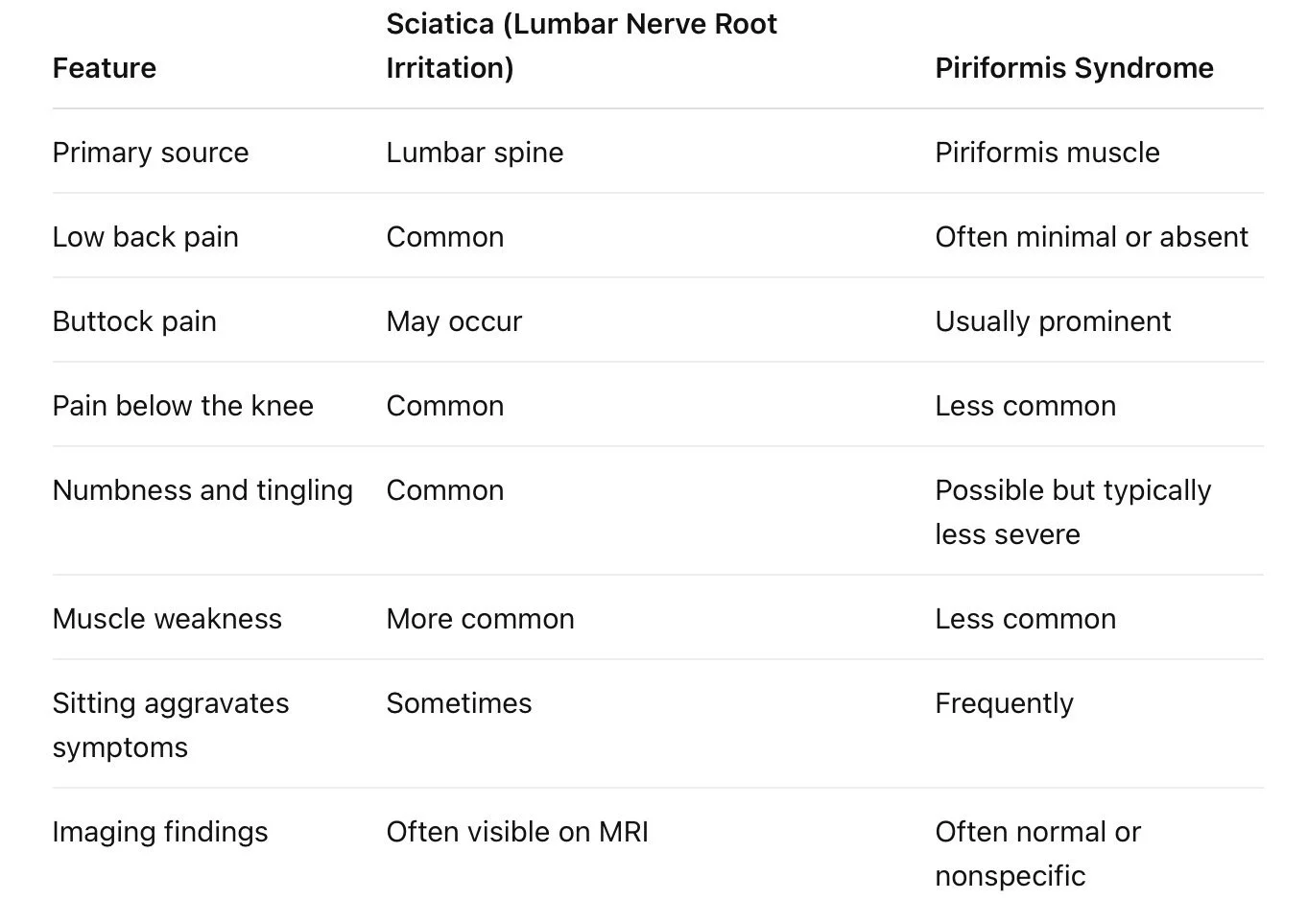
Sciatica vs. Piriformis Syndrome: Key Differences
Why Proper Diagnosis Matters
Because both conditions can produce pain that travels down the leg, piriformis syndrome is sometimes mistaken for lumbar sciatica—and vice versa.
Research suggests that piriformis syndrome is largely a diagnosis of exclusion, meaning clinicians should first rule out more common causes such as lumbar disc herniation or spinal stenosis before attributing symptoms to the piriformis muscle. (PMC)
An accurate diagnosis may involve:
Detailed history
Orthopedic and neurological testing
Movement assessment
Lumbar spine examination
Hip examination
Imaging when appropriate
How Conservative Care Can Help
Treatment depends on the underlying cause.
For lumbar-related sciatica, management often focuses on reducing nerve irritation, improving spinal mobility, and restoring normal movement patterns.
For piriformis syndrome, treatment typically emphasizes reducing tension within the piriformis and surrounding tissues while improving hip and pelvic function.
Research supports conservative management approaches such as exercise therapy, manual therapy, stretching, and activity modification for many patients experiencing sciatic-type pain. (PMC)
Chiropractic care may play a role in both conditions by addressing joint dysfunction, movement restrictions, muscular imbalances, and biomechanical factors that contribute to nerve irritation. A comprehensive examination helps determine whether symptoms are more likely originating from the lumbar spine, the deep gluteal region, or a combination of both.
The Bottom Line
Not every case of leg pain is true sciatica, and not every case of buttock pain is piriformis syndrome. While both conditions can produce similar symptoms, they originate from different structures and often require different treatment strategies.
If you are experiencing persistent pain that travels into the leg, obtaining an accurate diagnosis is the first step toward effective treatment. Identifying whether the source is coming from the spine, the piriformis muscle, or another structure entirely can help guide a more targeted recovery plan and reduce the risk of ongoing or recurring symptoms.
